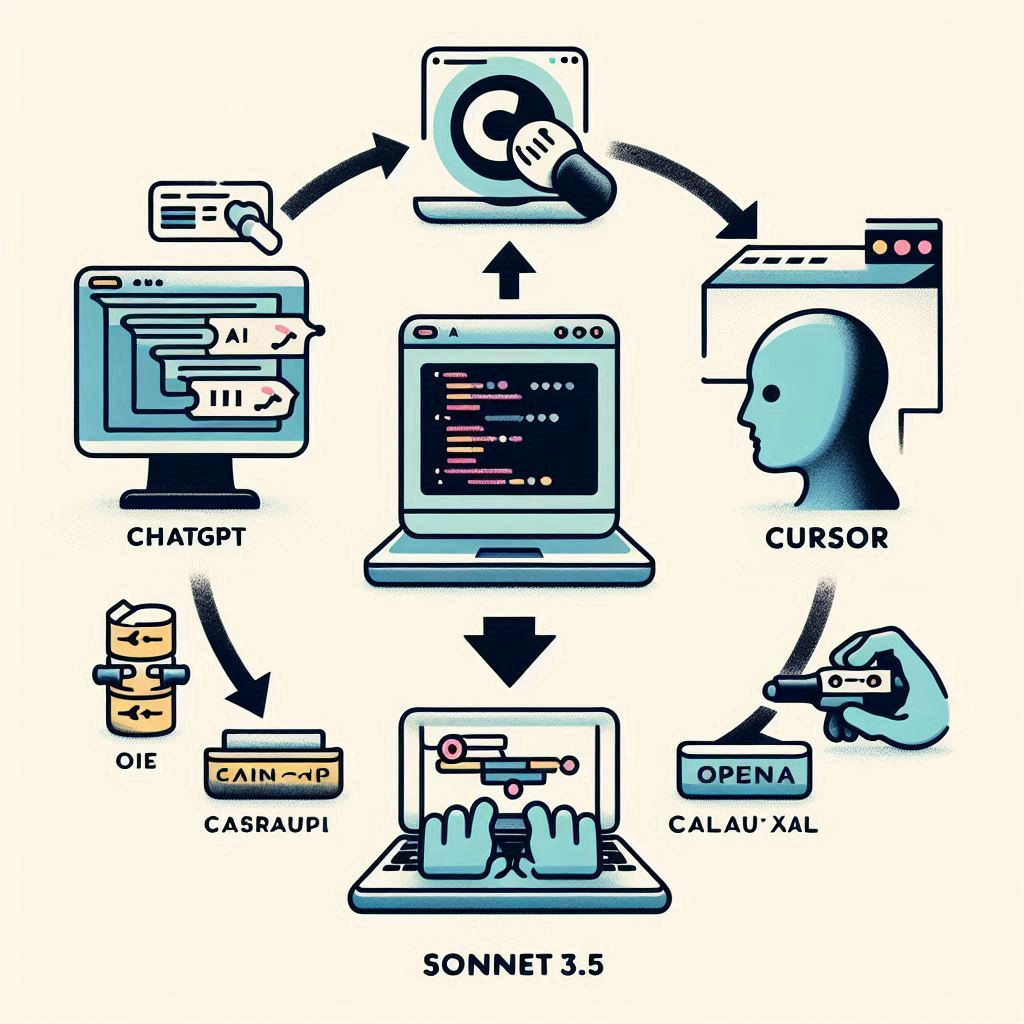
As a longtime Visual Studio Code user, I mostly code in Python with some JavaScript on the side. Like many developers, I was quick to adopt AI tools when ChatGPT first launched. That early experience was rough around the edges—useful but riddled with mistakes, requiring careful prompting and revision.
Fast forward to today, and AI coding assistants have matured significantly. What was once a fun experiment has now embedded itself into my daily workflow. The shift came when developers began integrating AI more deeply into our tools—Cursor AI being a perfect example.
Cursor AI: Streamlining Development
Cursor AI, a fork of VS Code, integrates AI directly into the coding environment. It doesn’t need to be invoked as a plugin; it’s built-in, which lets it align with the natural rhythm of development. The Composer feature, in particular, allows me to input specifications in plain English and see them transform into production-level code. This isn’t about coding trivial “hello world” programs—it’s about rapidly developing actual applications, deploying APIs, and constructing full-stack systems, all without leaving the editor.
Cursor has been a major force multiplier in eliminating boilerplate tasks and setup. From Docker to Kubernetes, Composer handles it, freeing me up to focus on logic and architecture. Initially, I wasn’t sure how much I’d rely on it, but it quickly became indispensable for reducing friction in my workflow.
Claude Sonnet 3.5: Efficient Solutions
While Cursor smooths the development experience, Claude Sonnet 3.5 from Anthropic brings intelligence to the table. Claude excels at something other models often struggle with—clarity in reasoning. When problems aren’t straightforward, I rely on Claude. Its output is concise, often elegant, and it handles complex code-generation tasks with precision. It provides cleaner, more robust solutions than other models I’ve worked with, including ChatGPT.
The reason I tend to use Claude inside Cursor is simple: it works. Anthropic leaned hard into making their model fast and smart rather than bloated with unnecessary features. What I care about is how quickly and accurately a model can parse a problem and generate a solution, and Claude excels at that.
Cursor + Claude: A Powerful Combination
Cursor for development speed; Claude for refined problem-solving. They complement each other perfectly. Cursor accelerates the process, keeping everything flowing within a single environment, while Claude sharpens the output when more precise, elegant logic is critical. Together, they make the development process far more efficient, freeing up my cognitive bandwidth for tackling higher-level problems.
OpenAI’s o1: The Next Step
Just as it feels like I’ve found the right balance with Cursor and Claude, OpenAI’s o1 model launches. From my initial impressions, the o1 series represents a serious leap forward in reasoning and problem-solving depth. While slower compared to its predecessors, o1 seems built for tackling the kinds of multifaceted problems that developers often wrestle with—ones that require not just code generation but strategy and structure.
o1’s introduction continues the trend of AI becoming less of a tool for coding and more of a partner in development. It won’t replace Cursor or Claude for day-to-day use anytime soon, but it serves as a reminder that this space isn’t sitting still.
Looking Ahead
AI in development has come a long way in a short time, and it’s evolving quickly. Cursor AI and Claude Sonnet 3.5 have already transformed how I approach coding, making it faster and more refined. But with o1 entering the scene, and constant innovations from Anthropic, OpenAI, and others, we’re standing on the edge of yet another shift.
No one knows precisely what the next step will be, but it’s clear that we’re heading toward a future where AI plays an even more integral role, not just in automating tasks but in improving the quality and thoughtfulness of solutions.
Change is constant, but for developers willing to embrace these tools, the future is promising.
No responses yet